

How To Clean The Horn Contact On A Steering Wheel In A 1991 Mercury Capri
The wheel is one of the virtually fundamental inventions nosotros use in our everyday lives. Invented sometime around 3500 BCE, during the Chalcolithic era, the wheel gave rise to everything from transportation to modernistic-day machinery and almost everything in betwixt.
The cycle on its ain, while promising, is non very useful. Much like a doughnut, its most important feature is the hole in the centre. If it wasn't suitable for attaching a stable platform past combining information technology with an axle, the wheel would be nothing but a cylinder rolling on its edge. By the time the wheel and beam were invented, information technology was the Statuary Age. Casting metal alloys, constructing canals and sailboats, and circuitous musical instruments such as harps all predate the wheel and axle.
The idea of adding an axle isn't a simple one

For the system to work, the wheel must rotate freely around the beam. This is achieved by fitting the beam directly in the center of the cycle to maximize continuity during movement. In improver, the axle and the whole alignment must be perpendicular, to reduce friction. Furthermore, the beam should remain as thin as possible to reduce its surface expanse while still existence able to back up the load.
From hither, the only friction to overcome is that betwixt the inner bicycle and the beam. The smoother the inner surface of the cycle, and the outer surface of the beam, the less friction the system has to overcome.
The success of the whole structure was also sensitive to the size of the axle. A thick beam would generate also much friction, while a narrow one would reduce friction but would also exist also weak to back up a load. To solve this problem, the earliest wagons were small and narrow, and then they could have short, thin axles.
Not simply practise all these parameters have to be met for this structure to work, but all at the same time. It may be for this reason that such a unproblematic concept took and then long to gain traction.
Archaeologists argue that some other limiting factor was the demand to carve wood for the wheel and axle very precisely. For this, metal tools would have been necessary — which perhaps explains why the wheel and axle were non invented until after cast copper chisels and gouges became common.
The complex number of factors that had to exist overcome in order to make the bicycle and axle work meant that it could not have been developed in phases. It had to come up all at once. In fact, many archaeologists believe that the bike and beam were only invented once, in one identify, and spread from at that place.
We are not actually certain when or where the wheel originated
Where thewheel and axle originated is a mystery, but its use spread throughout Eurasia and the Centre East rapidly. Some of the primeval images of wheeled carts take surfaced in Poland, suggesting the region may take seen some of its outset utilize.
Asko Parpola, an Indologist at the University of Helsinki in Finland, suggests that the wheel originated with the Tripolye people of modern-mean solar day Ukraine. This is based on the fact that the give-and-take 'wheel' is derived from their language.
There is show to propose that the earliest apply of the wheel may have been in potter's wheels in Mesopotamia, 300 years before it was adapted to fit the chariot.
The wheelbarrow, however, is believed to have commencement appeared in aboriginal Greece betwixt 600 - 400 BCE. People's republic of china followed former subsequently and the wheel and axle eventually establish their way to medieval Europe. Although the wheelbarrow was a high-priced commodity at the fourth dimension, it would pay for itself within a few days, as it greatly increased the amount of work that could be done by a single worker.
Archaeologists in Vera Cruz, United mexican states, unearthed ceramic toys in the form of lilliputian animals. The animals were fitted with wheels instead of legs, so children could push them forth. Notwithstanding, the region did not utilize the bicycle for transportationuntil the inflow of the European settlers. This may have been to practise with the terrain, however, rather than a lack of know-how.
In the Heart East and North Africa, where there are vast areas of desert, the camel was still the preferred way of transport, correct up until 600 A.D. This could exist considering camels tended not to sink or go stuck in the sand, while thin wooden wheels did. Richard Bulliet gives several other possible reasons in his 1975 book,The Camel and the Wheel. Middle Eastern societies did brand employ of wheels for practices such as irrigation, milling, and pottery.
It is non surprising that subsequently all of this, the basic design of something every bit robust as the wheel and axle hasn't inverse in over 6000 years.
What were the early uses of the cycle?

As we mentioned, wheels were not at first used for transportation. Early wheels consisted of a wooden disk and hole for the axle did play a vital role in early societies. They were unremarkably used for pottery, irrigation, and milling. Information technology took hundreds of years for the wheel to make its way onto the first chariots.
No wheels be in nature

When is the last time that you saw a wheel in nature? Many of the world's nigh life-changing inventions were direct inspired past nature. From the fork to the airplane and velcro, many technologies involve some form of biomimicry. Except for the wheel. It is1 hundred percent man sapien innovation.
However, some argue that the idea of the bike does appear in nature. One example tin can exist found in Dung Beetles. Dung beetles lay their eggs in dung (which serves every bit food for the larvae) and send them by rolling the dung into a ball. Other potential inspirations, according toMichael LaBarbera — a professor of biological science and anatomy at the Academy of Chicago — include "wheeled organisms" and tumbleweeds.
"Bicycle of Fortune" is more than than just a game evidence
The cycle of fortune is not merely an American television game prove. In fact, it is a concept in medieval philosophy that symbolizes fate. The wheel belongs to the goddess Fortuna who spins the wheel to determine the fates and misfortunes of mortals. Fortuna is oft depicted as a blindfolded woman spinning a giant wheel.
The most mutual design for a perpetual motion device is the overbalanced cycle
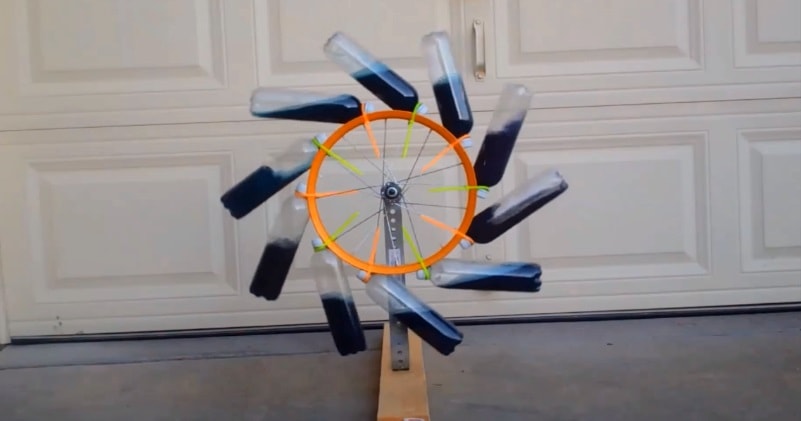
The concept of perpetual motion machines has been around for centuries. Information technology is the holy grail of science, and if it were to be accomplished, it would produce gratuitous free energy in one case it is gear up in motility. Perhaps the most famous example is Bhāskara's bike. Invented in 1150 by Bhāskara II, an Indian mathematician, the wheel-automobile was an attempt to create a perpetual-motion machine. The wheel consisted of curved or tilted spokes partially filled with mercury.
The mercury was intended to shift mass to a larger radius from the bicycle's axle,unbalancing the cycle to sustain rotation in one direction. In the end though, friction and entropy do their piece of work and the move slows and and so stops.
Using wheels to create optical illusions
At that place is a concept in moving-picture show chosen aliasing. This is when a rotating cycleis illuminated past flickering lite so that itappears to be spinning. Pic cameras piece of work by capturing a series of still images, they then play these images in sequence at roughly 50 frames per second. This is enough to fool our brains into thinking that the paradigm is moving. However, if the bike is moving faster than the frame charge per unit, the rotation surpasses the paradigm capturing frequency and the bicycle appears to be moving backwards.
For case: If a spoke of the bike is at the 12 o'clock position in the get-go frame, and then in the 2d frame that spoke moves almost a full rotation to the 11 o'clock position. Your brain will interpret that as moving anti-clockwise as it cannot determine what is happening between frames. At the correct frequency, a strobe low-cal or even a fluorescent lamp can have the aforementioned effect.
Ever wondered where the term fifth wheel comes from?
A fifth cycle was one that extended from the front axle of a carriage to prevent information technology from tipping over. Much similar a drag racer has on its rear. Virtually of the time it was never used and landed up being redundant, hence, past calling someone or something 'a fifth wheel' you are referring to them as unnecessary.

Source: https://interestingengineering.com/the-history-and-evolution-of-the-wheel
Posted by: glovertheman.blogspot.com
0 Response to "How To Clean The Horn Contact On A Steering Wheel In A 1991 Mercury Capri"
Post a Comment